
Am I Eligible for Weight-Loss Medication in the UK? BMI and Health Criteria Explained
By Andrew Herman · 23 October 2026
Medically reviewed by Dr Chris Herman, GMC 2376587
Last reviewed 23 October 2026
If you have been considering weight-loss treatment with a GLP-1 medication such as Mounjaro, Wegovy or Foundayo, one of the first questions people ask is: 'Am I eligible for treatment?' This article takes you through how eligibility is generally assessed in the UK, so you have a basic understanding before getting in touch – although it is important to note that only a qualified medical professional can review your health care history to determine whether treatment is right for you.
The starting point: BMI
Body Mass Index (BMI) is the main eligibility criteria used across UK prescribing guidance for GLP-1 medications, whether through NHS pathways or private clinics. BMI is a measure of how much you weigh against your height.
The general thresholds are:
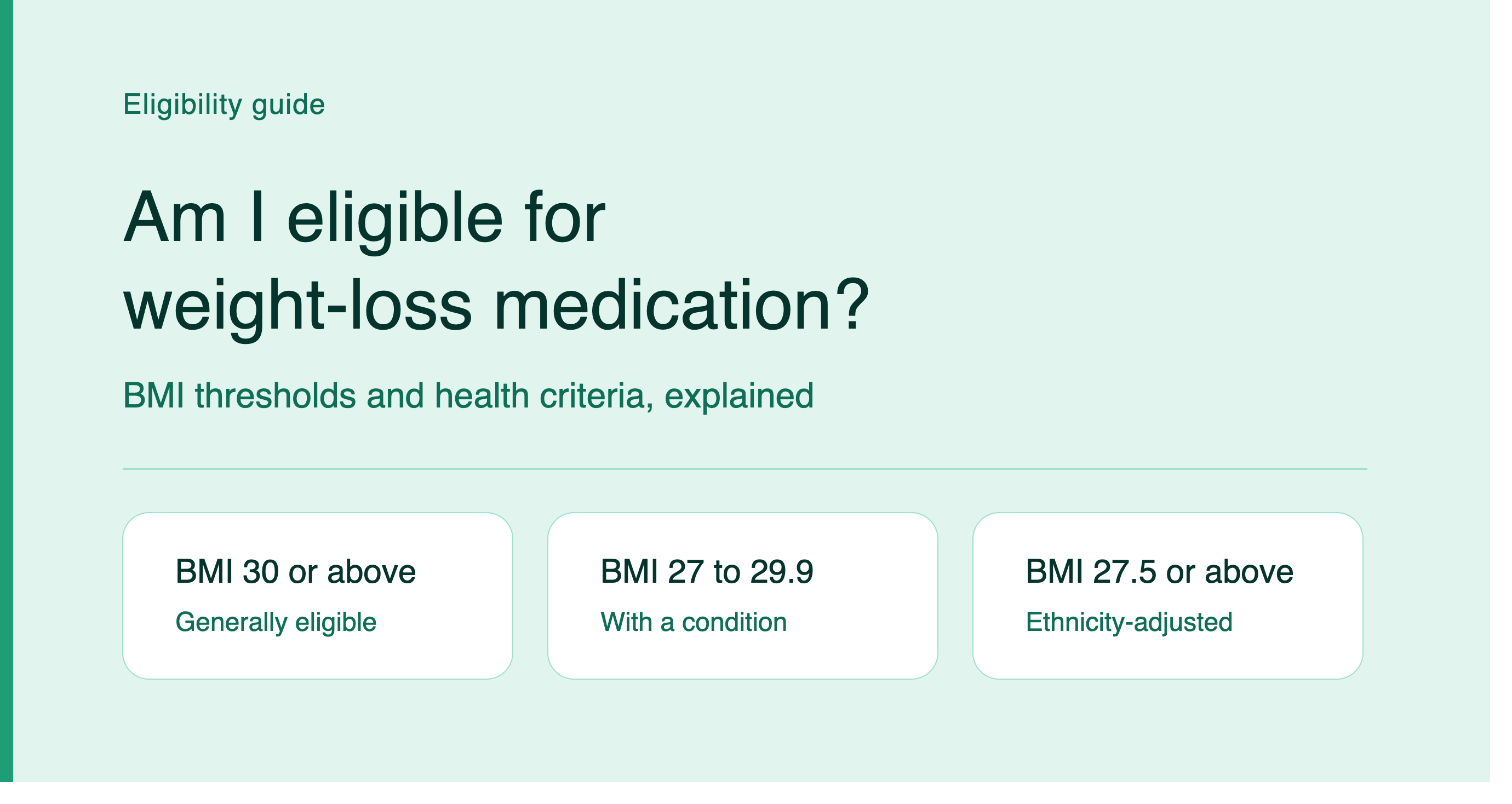
BMI of 30 or above – generally sufficient on its own to be considered eligible for treatment.
BMI of 27.5 to 30.0 – treatment can usually still be considered, but it requires at least one weight-related health condition alongside your BMI, or that you are from certain ethnic backgrounds.
The 27.5 to 30.0 'with a condition' band exists because, at a lower BMI, the medical case for treatment is usually made stronger by a pre-existing health risk that weight loss would help to address, rather than by BMI alone being the sole deciding factor.
The conditions that count
If your BMI falls in the 27.5 –30.00 range, the pre-existing health conditions recognised by the National Institute for Health and Care Excellence (NICE) as supporting treatment with a GLP-1 are:
Type 2 diabetes or prediabetes – this includes if you have been told that you have elevated blood sugar levels
Hypertension – high blood pressure
Dyslipidaemia – high cholesterol or abnormal blood fat levels
Obstructive sleep apnoea – a sleep condition involving repeated pauses in breathing during sleep, often with loud snoring
Cardiovascular disease – a history of heart attack, angina, stroke, heart failure or peripheral arterial disease
Some other conditions, such as osteoarthritis, polycystic ovarian disease (PCOS) or fatty liver disease, are sometimes also considered as supporting factors by individual clinicians when determining treatment eligibility. If you have one of these conditions, it is advisable to disclose it to your clinician so that they can take it into account when looking at your overall health.
A note on ethnicity and BMI
BMI thresholds do not apply equally to everyone. NICE guidance increasingly recognises that people from certain ethnic backgrounds – including South Asian, Chinese, other Asian, Middle Eastern, Black African and African-Caribbean – tend to experience weight-related health risks at a lower BMI than the White British population. This means that a lower BMI threshold can apply: for example, some clinicians use a BMI of 27.5 (rather than 30) as being the minimum threshold without an underlying weight-related condition, or a BMI of 25.0 where a comorbidity is present.
Clinicians now generally ask patients for their ethnicity in order to confirm which thresholds should be applied. If your clinician does not do this and you are from an ethnic minority background, we would recommend raising it with them directly.
A quick clarification: NHS versus private prescribing
You will likely see different criteria quoted and applied in different clinical settings. For example GPs are able to prescribe Mounjaro to patients with a BMI of over 35 with 4 out of 5 weight-related health conditions. Prescribing under the NHS is significantly restricted due to funding and capacity constraints.
Private prescribing, such as the service we offer, follows wider criteria, in line with the licensed indications approved by the Medicines and Healthcare products Regulatory Agency (MHRA) for these medications (BMI of 30 and above, or 27.5 and above with a qualifying condition or where a lower threshold applies on the basis of ethnicity). This is why GLP-1 medications are more accessible through private routes than through NHS specialist services, even where the underlying medical thresholds are similar.
What underlying conditions would rule treatment out?
Eligibility for GLP-1 weight-loss medication is not solely about BMI and qualifying conditions – there are other important factors to consider. Some circumstances are contraindications, meaning that these medications are not suitable irrespective of BMI or any qualifying conditions. These include:
being pregnant, trying to conceive or breastfeeding
a personal or family history of medullary thyroid carcinoma (MTC)
Multiple Endocrine Neoplasia type 2 (MEN2) – a rare inherited condition
Hypersensitivity to specific GLP-1 medications or their ingredients
It is important that any such circumstances or conditions are disclosed to your clinician before starting treatment. Every clinician should carry out a thorough medical history assessment with each patient beforehand, to make sure that the medication can be prescribed safely.
How we assess eligibility
At the Slimming Doctor, we ask you to submit detailed medical and lifestyle questionnaires before being reviewed thoroughly by our lead GP who will then discuss them with you during a video consultation – this covers your BMI, medical history, any relevant health conditions, medication history, your lifestyle and anything else that might affect suitability before a decision is made to prescribe medication and start treatment.
Next steps
If you would like to understand more about how these medications actually work, our guide to GLP-1 medications explains the science and compares the options available. If you are ready to find out whether you might be eligible, you can get in touch with us to begin the process – there is no obligation, and nothing will be decided until you have spoken with our lead GP.